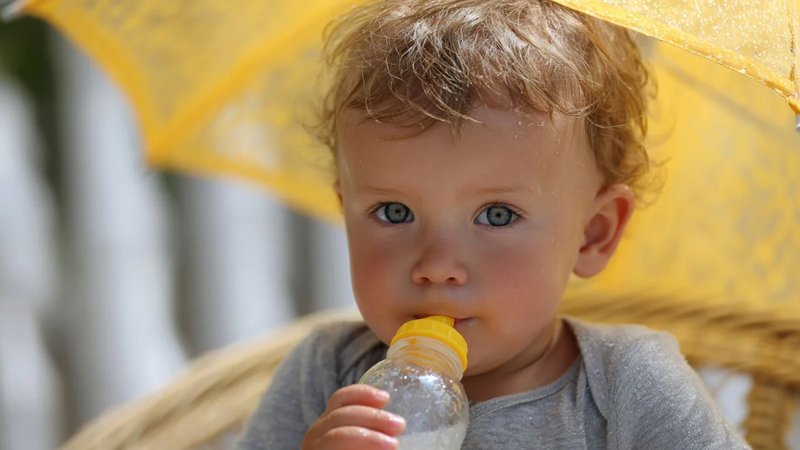
Why I Stopped Leaving Formula Out During Portland's Brutal July Heat
By Emily Hartwell
I made a mistake last Tuesday that still makes my stomach turn. At 2:47 PM, while the thermometer on my porch read 103°F, I grabbed a bottle I'd mixed two hours earlier and handed it to my daughter. She took three sips. Made a face. I sniffed it. Sour. Not obviously rotten, but off enough that I dumped the whole thing down the sink and spent the next twenty minutes Googling "baby formula bacteria 100 degrees" while she cried from hunger.
Portland doesn't do heat like this. Or at least, it didn't use to. I grew up here. I remember summers that barely touched 85°F. Now we've got consecutive days over 100°F, and the wildfire smoke from the eastern Oregon fires drifts in by Thursday like clockwork. The air quality app on my phone has become as important as the baby monitor. And nobody warned me that formula feeding in a heat wave requires an entirely different playbook than the one I memorized from the pediatrician's pamphlet.
Here's what actually happens when you mix formula in 95-degree heat. The powder itself is shelf-stable, sure. But the moment you add water—especially tap water that's been sitting in pipes that have baked in the sun—you've created a bacterial playground. The CDC says mixed formula is safe at room temperature for two hours. But "room temperature" assumes 68-72°F, not the 88°F my kitchen reached last Saturday afternoon. At those temps, the two-hour window shrinks. How much? Nobody gives you a straight answer. I called my pediatrician's office. The nurse said "use your judgment." Thanks, Karen. My judgment is currently running on four hours of sleep and a cold brew that went warm an hour ago.
I started keeping a log. Obsessive? Maybe. But when your baby is four months old and you've already had one formula scare, you get obsessive. I wrote down the time I mixed each bottle, the indoor temperature, where I stored it, and how long it sat. After two weeks, a pattern emerged that made me genuinely angry at how little practical advice exists for parents in extreme heat zones. The parenting forums are full of judgmental nonsense about breastfeeding versus formula, but almost nothing about the physics of milk powder in a heat dome. It's like the entire baby-care industry assumes we all live in climate-controlled suburban homes with central air and a backup generator.
At 78°F indoor temp, a mixed bottle lasted about 90 minutes before it started smelling different. Not bad, just different. That faint metallic edge that tells you something is changing at the molecular level. At 85°F, that dropped to 60 minutes. At 92°F—and yes, my apartment hit 92°F because I have one window unit and a west-facing wall that turns into a solar panel after 2 PM—I wouldn't trust a bottle past 45 minutes. And if the wildfire smoke was heavy enough that I had the windows closed and the AC recirculating? The humidity trapped inside made it even worse. The formula didn't just warm up; it got that slick, almost oily texture that means the fats are breaking down. I learned to recognize that texture. It's subtle, but once you've seen it, you can't unsee it. Like the difference between fresh cream and cream that's about to turn.
I tried the ice pack trick. You know the one—stick the bottle in a cooler with an ice pack, bring it out when baby is hungry. Works great for car trips. Terrible for home use. The temperature shock from 35°F to 98°F when the baby starts drinking creates condensation on the outside of the bottle, which drips onto whatever fabric is nearby, and more importantly, the cold formula gave my daughter stomach cramps. Not every time, but enough that I stopped doing it. Pediatrician confirmed: cold formula isn't harmful, but some babies' digestive systems object to the temperature swing. Their little guts are sensitive. Everything is new to them. Even room temperature is a concept they're still figuring out.
The powder storage was another revelation. I kept the formula canister in the cabinet above the stove. Stupid. That cabinet gets warm every time I cook, and during a heat wave, it's basically an oven. I moved it to the pantry, which stays cooler, but even then, I noticed clumping after a week. The humidity. Portland's not supposed to be humid, but when it's 100°F and the air is thick with wildfire particulates, everything feels damp. The scoop started sticking to the inside of the lid. Tiny orange flags that the powder was absorbing moisture and potentially degrading. I started tapping the canister before opening it, listening for the sound of loose powder versus compacted chunks. It's a small thing, but when you're measuring out eight scoops a day, you notice.
I started buying smaller canisters. More expensive per ounce, but I was throwing away less. And I started refrigerating the powder. Yes, refrigerating it. Not freezing—just keeping it in the fridge in an airtight container. Controversial? The internet thinks so. Every parenting forum has at least one person who will scream at you that "the manufacturer says room temperature." But I found a 2019 study from the Journal of Food Protection that tested powdered infant formula storage at various temperatures and humidity levels. At 90°F and 70% humidity, the bacterial load in opened containers increased by 40% over two weeks. At 40°F (refrigerator temp), the increase was negligible. The study didn't recommend refrigeration because most manufacturers don't test for it, but the data was clear. I showed it to my pediatrician. She shrugged and said "can't hurt." That was enough for me. Sometimes "can't hurt" is the highest praise a sleep-deprived parent is going to get from the medical establishment.
The water issue is the one that really gets me, though. Portland's water is great. Some of the best in the country. But when the pipes are hot, the water coming out of the tap is hot too. Not just warm—hot. I measured it at 82°F one afternoon using a meat thermometer because I was curious and also slightly unhinged. The WHO recommends mixing formula with water that's been boiled and cooled to "lukewarm," which they define as around 98°F. But if your tap water is already 82°F, and you boil it and let it cool in a 90°F apartment, it doesn't cool to 98°F. It cools to whatever the ambient temperature is. Physics doesn't care about your feeding schedule. I started keeping boiled water in the fridge and warming bottles in a mug of hot water when needed. Added five minutes to every feeding. Worth it. My daughter stopped making that confused face when the bottle touched her lips, the one that said "this is not the temperature I was expecting."
And then there's the wildfire smoke. The PM2.5 levels last week were so high that the health department issued warnings for infants and elderly to stay indoors. My daughter doesn't go outdoors much anyway—she's four months old, not training for a marathon—but the smoke seeps in. Through window seals. Through the bathroom vent. The air inside my apartment smelled like a campfire for three days. I bought a HEPA air purifier that cost more than my first car payment, and I don't regret it. But the stress of wondering whether the smoke particles were affecting her respiratory system while I was trying to figure out if her formula was still safe? That was a special kind of parental hell. I couldn't open the windows to cool the apartment because the air was toxic. I couldn't run the AC on full blast because the compressor would overheat. I was trapped in a 92-degree box with a hungry baby and a growing pile of questionable bottles.
I've started making bottles in smaller batches. Two ounces at a time instead of four. More work, less waste. I keep a digital thermometer in the kitchen now, not just for cooking but for formula safety. I have a dedicated "formula zone" in the coolest corner of my apartment—a folding table next to the north-facing window that never gets direct sun. It looks ridiculous. Like a tiny laboratory. There's a thermometer, a timer, a notebook, and a small cooler that I use as a mini-fridge for mixed bottles. My partner walked in last week and asked if I was running a meth lab. I told him I was running a milk lab. He didn't laugh. He doesn't get it. He works in an office with central air. He comes home and the apartment is a sauna and I'm sitting there in my underwear with a baby on my hip, measuring water temperature like it's a chemistry experiment.
The thing nobody tells you is that formula feeding in extreme heat isn't just about following the rules on the can. It's about adapting those rules to your actual environment. The guidelines were written for climate-controlled nurseries in suburban Ohio, not for apartments in Portland during a record-breaking heat dome with air quality warnings. You have to become a kind of amateur food safety scientist, which is not what you signed up for when you decided to have a baby. You signed up for snuggles and first smiles and maybe some sleepless nights. You did not sign up for calculating bacterial growth rates in your kitchen.
My neighbor, who formula-fed her twins in Phoenix, laughed at me when I complained about 103°F. "That's a Tuesday in June," she said. She told me about insulated bottle bags, about pre-measuring powder into travel containers so you only add water when needed, about keeping a cooler with ice packs specifically for formula in the nursery. Phoenix parents have this figured out because they have to. Their summers start in April and don't end until Halloween. Portland parents are still catching up because our infrastructure—our assumptions, our habits—was built for a cooler climate that's disappearing. We don't have evaporative coolers. We don't have covered parking that keeps cars from becoming ovens. We have rain jackets and umbrellas and a collective memory of mild summers that doesn't match the reality outside the window.
I'm angry about it, honestly. Angry that the formula companies don't put heat-specific warnings on their labels. Angry that the parenting books have a single paragraph about storage temperatures that assumes everyone lives in a 72-degree house. Angry that I had to learn this through trial and error while my daughter's safety was on the line. But I'm also practical. She's healthy. She's gaining weight. She hasn't had a single stomach issue since I implemented my ridiculous laboratory system. And when the heat breaks—when Portland goes back to being the mild, rainy city I remember—I'll have a set of skills that most parents here never needed before but absolutely will need again.
Because the heat isn't going away. The wildfires aren't going away. And formula-feeding parents in the Pacific Northwest need to stop pretending that the old rules still apply. They don't. We need new ones. And until someone writes the definitive guide, we're all figuring it out one sour bottle at a time. One clumped canister. One overheated kitchen. One anxious Google search at 3 AM.
What storage hacks have you figured out that the baby books never mentioned? I'm still looking for better solutions. And if you're a formula company executive reading this for market research, put a heat warning on your can. It's not that hard.
Last Thursday, I actually called the formula manufacturer's customer service line. I was on hold for seventeen minutes, which is an eternity when you have a baby who might wake up any second. When I finally got through, the representative read me the same storage instructions that are printed on the can. I asked her specifically about temperatures above 90°F. She paused. I could hear her clicking through something on her end. Then she said, "We recommend storing in a cool, dry place." I asked what "cool" meant in degrees. She said she didn't have that information. I asked if there was a food scientist I could talk to. She transferred me to a voicemail box that was full. I hung up and stared at my phone for a long time, wondering how many other parents had made that same call and gotten that same non-answer.
I started looking at the actual science. Not the marketing materials, but the peer-reviewed studies. There's a 2021 paper from the International Dairy Journal that looked at lipid oxidation in infant formula stored at high temperatures. They found that at 86°F, the oxidation rate doubled compared to 68°F. At 104°F, it quadrupled. Oxidized fats aren't just less nutritious; they can produce compounds that irritate a baby's digestive system. The study used controlled lab conditions, not my kitchen, but the trend was undeniable. Heat destroys the good stuff and potentially creates bad stuff. And yet, the formula can in my hand says nothing about this. It says "store in a cool, dry place." That's it. Four words that are supposed to cover everything from Anchorage to Austin to my overheated apartment in Southeast Portland.
My mother-in-law, who lives in Michigan where summers are mild and central air is standard, told me I was overthinking it. "We left bottles out all day when you were a baby," she said. "You turned out fine." I love her, but she's wrong. Not about me turning out fine—I did, mostly—but about the comparison. The world she raised babies in doesn't exist anymore. The climate has changed. The heat is different. The air is different. And the bacteria that live in our kitchens have evolved to thrive in the conditions we've created. What worked in 1995 is not what works in 2026. I didn't say this to her. I just smiled and changed the subject. Some battles aren't worth having with your mother-in-law. But the data is clear: the old rules are obsolete.
I've started taking pictures of my "formula zone" and sending them to other Portland moms I know. Not to brag, but to show them what's possible. The north-facing window. The cooler. The thermometer. The logbook. It looks extreme, but it's not. It's just what adaptation looks like when the environment changes faster than the advice does. One of them, a nurse at OHSU, told me she's started doing the same thing. She sees the heat-related illness data coming in. She knows what's happening. And she knows that the official guidance hasn't caught up to the reality on the ground. "We're making it up as we go," she said. "But at least we're making it up with data." That might be the best description of modern parenting I've ever heard.
So here's my current system, for anyone else sweating through a heat wave with a formula-fed baby. Keep the powder in the fridge in an airtight container. Boil water in the morning, cool it in the fridge, and use it throughout the day. Mix bottles two ounces at a time. Store mixed bottles in a cooler with an ice pack if the indoor temp is above 85°F, and use them within 30 minutes of removing them. Keep a log. Trust your nose. When in doubt, throw it out. And buy a HEPA purifier if the wildfire smoke is bad, because you can't open the windows and you can't let the apartment turn into an oven. It's not perfect. It's expensive. It's time-consuming. But it's what works when the world outside is 103°F and the air smells like burning pine.
