The Summer Heat Wave Made Me Rethink Every Bottle
It was 94 degrees in Portland last Tuesday. I know because I checked the thermometer on our back porch at 2:47 AM while holding a screaming Lily. The air conditioning in our bungalow on Powell Boulevard had given up sometime around midnight. Lily was sweating through her onesie. I was sweating through my shirt. And the bottle of formula I had mixed three hours ago was sitting on the counter, probably breeding bacteria at a rate that would make my microbiology professor proud.
I stood there in the dark, wondering if I was supposed to throw it out. The can said "use within two hours." But that was room temperature. What counted as room temperature when your kitchen was basically a sauna? Was 85 degrees still "room temperature"? Was 90? I had a degree in nutrition science from Oregon State and I genuinely didn't know.
That's the thing about formula feeding in a heat wave. Nobody talks about it. The Instagram moms are all posting pictures of their babies in splash pads and sun hats. Nobody is posting about the 3 AM math problem of whether your baby's bottle is still safe when the indoor temperature rivals a Florida afternoon.
I called OHSU the next morning. Not the NICU where I used to work — I still have friends there, but I didn't want to abuse the connection. I called the general pediatric line. The nurse, whose name was Denise, listened to me ramble about bacterial growth rates and the two-hour rule for a solid four minutes before gently interrupting.
"Emily, honey. Throw it out. Just throw it out. Formula is cheap. Your peace of mind is not."
I wanted to hug her through the phone.
But here's what really got me thinking. If I — a registered dietitian who spent three years in the NICU — was this confused about formula safety in extreme heat, what were other parents doing? The single dad in my building who works nights at Fred Meyer? The mom I saw at the Winco on 82nd who was buying generic formula with a WIC card and looked like she hadn't slept in a week?
I started doing the math that afternoon. Not just the formula math — the cost math. Lily goes through about 28 ounces of formula a day. In normal weather, I might waste one bottle a week because she didn't finish it or I left it out too long. In this heat wave? I was throwing out two, sometimes three bottles a day. At $1.87 per ounce for the hypoallergenic stuff she needs, that was roughly $15 a day going down the drain. For a week, that's $105. For a month of Portland summer heat? We were looking at $400 in wasted formula.
I sat down at the kitchen table with a calculator and a cold coffee — because of course I was still drinking caffeine, I'm not a saint — and I started mapping out a heat-wave feeding protocol. It felt ridiculous. Like I was writing a military operations manual for baby bottles. But you know what? It helped.
The first rule was simple: smaller bottles, more frequently. Instead of six-ounce bottles every four hours, I switched to four-ounce bottles every two and a half hours. Less sitting out. Less waste. Lily actually seemed happier — she wasn't getting that halfway-through-the-bottle slump where she slowed down and the rest got warm.
The second rule was about storage. I pulled out the insulated bag I used for hiking snacks and designated it the "bottle cooler." Two ice packs, four bottles, kept in the coolest corner of the apartment. When Lily needed a feed, I pulled one out. It was cold, which she actually seemed to prefer in the heat. I felt like a genius. Mark looked at me like I had lost my mind, but he also wasn't the one getting up at 2 AM to do bacterial risk assessments.
I talked to my friend Rachel, who still works in the NICU. She told me they had seen three cases of formula-related diarrhea in the past two weeks. Not severe — no hospitalizations — but enough to make the parents panic. "It's always the heat," she said. "Bacteria love warm formula. It's basically a petri dish."
That image stuck with me. A petri dish. That's what I was feeding my daughter when I got lazy about the two-hour rule.
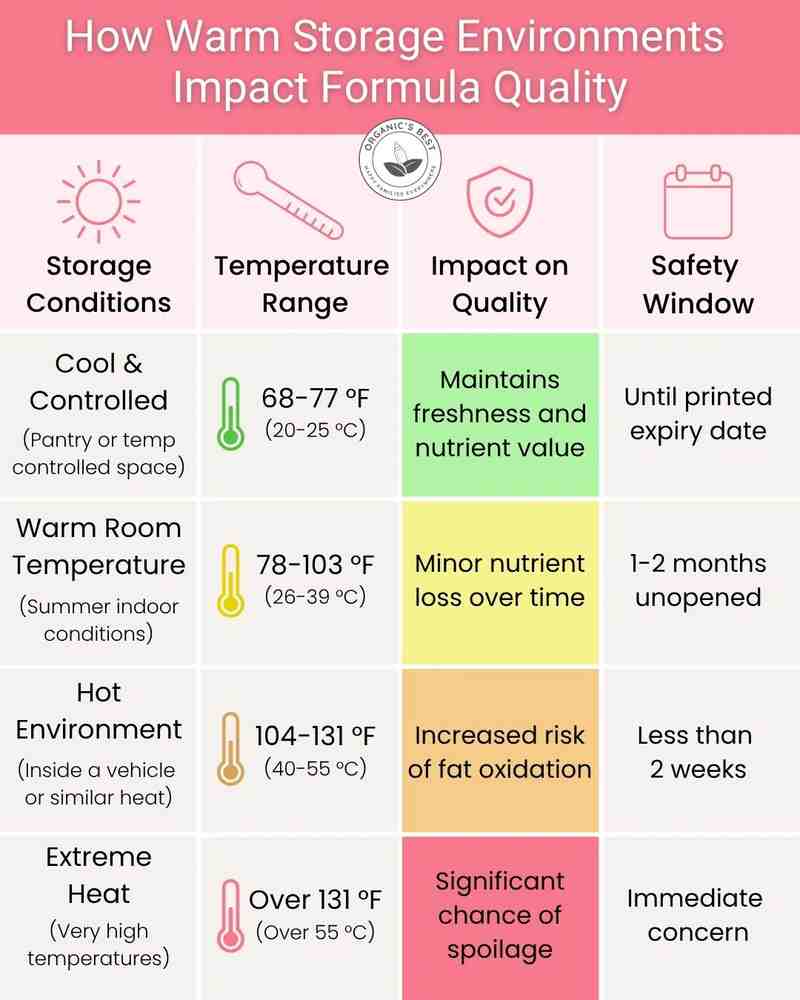
Here's what I learned, and what I'm passing on because I wish someone had passed it to me: The two-hour rule is not a suggestion. It's not "two hours unless you're tired." It's two hours at room temperature (defined as 68-77°F). Above 77°F, the window shrinks. At 85°F, you've got maybe an hour. At 90°F? Don't risk it. I know formula is expensive. I know throwing it out feels like throwing money away. But I also know what a dehydrated baby looks like, and trust me — you do not want to see that.
I started keeping a log. Old habit from my clinical days. Time mixed, temperature of the room, time discarded. After a week, I had data. I showed it to Mark with the kind of pride I usually reserve for successfully parallel parking on Hawthorne.
"You've tracked 47 bottles," he said, looking at my spreadsheet. "That's... a lot of tracking."
"Forty-seven bottles, 12 discarded, $22.44 in waste. Down from $105 the week before."
He blinked. "You reduced waste by 78%?"
"I told you. Data."
The heat wave broke on Friday. The AC got fixed. Lily slept through the night for the first time in a week, and I woke up at 6 AM feeling like I had been hit by a truck in the best possible way. But I kept the log. I kept the smaller bottles. I kept the cooler bag in the corner of the kitchen, because August is coming, and September in Portland can surprise you.
If you're feeding formula through this summer — or any summer, or any heat wave, anywhere — here's my advice. Don't trust the can alone. Trust your nose, your eyes, and the thermometer. When in doubt, throw it out. And maybe invest in a good cooler bag. They're not just for wine anymore.
— Emily, from a finally-cool apartment on Powell Boulevard
